


Access to affordable credit remains the single biggest constraint for small businesses in India. The gap is not in the willingness of banks to lend it is in the disconnect between what banks need to see (structured documentation, credit history, collateral) and what a typical MSME owner has (a running business, cash flows, and not much else on paper).
This guide walks through every dimension of MSME lending in India the loan types available, what banks actually look for, how to improve your chances, and the government schemes that can materially reduce your cost of borrowing.
What counts as an MSME?
Since the 2020 revised classification [2], MSMEs are defined by investment in plant & machinery/equipment AND annual turnover. Micro: investment up to ₹1 crore and turnover up to ₹5 crore. Small: investment up to ₹10 crore and turnover up to ₹50 crore. Medium: investment up to ₹50 crore and turnover up to ₹250 crore. Udyam Registration is mandatory for accessing scheme benefits and is free of cost.
Types of MSME Loans Available in India
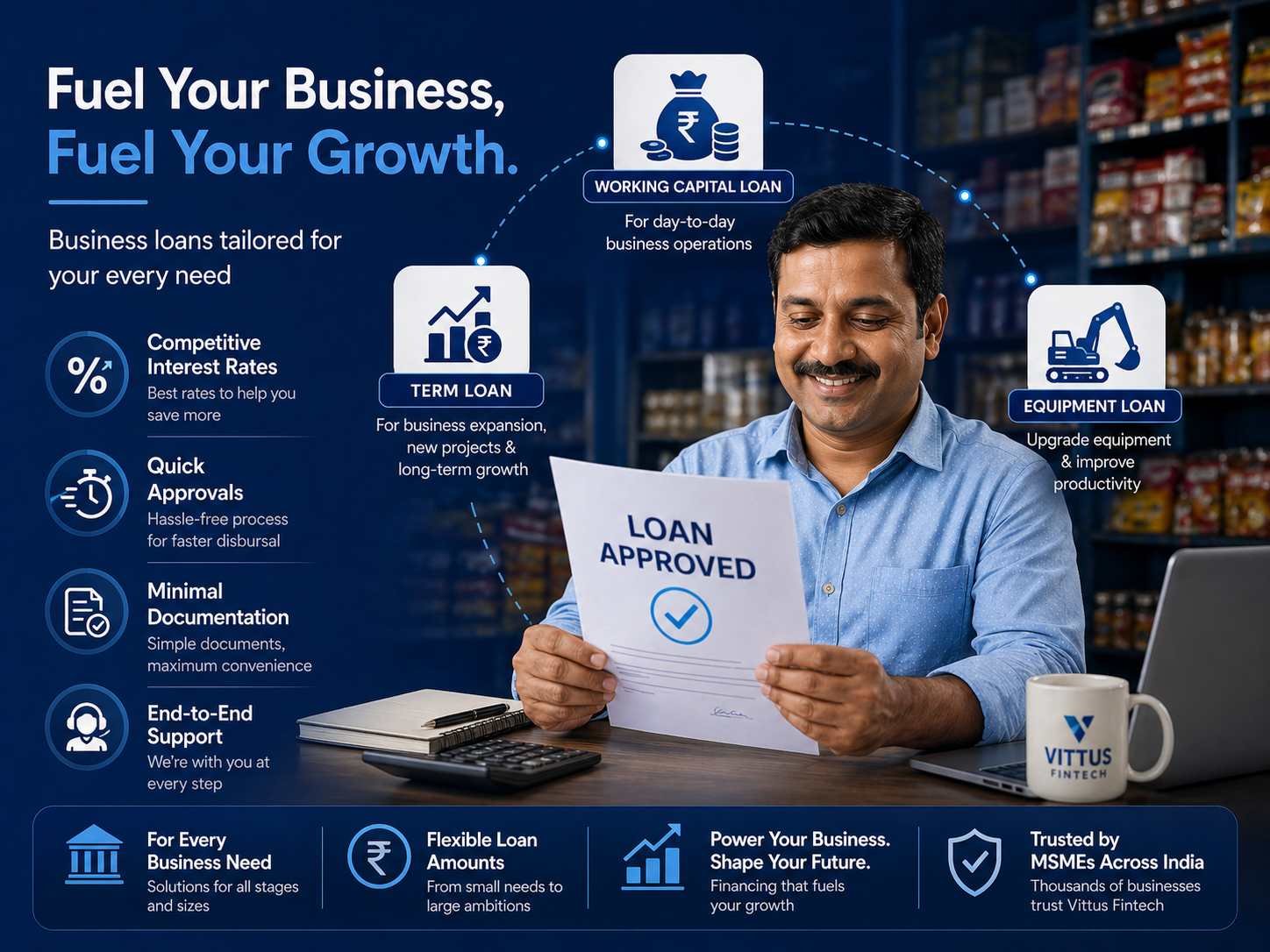
- Term Loan– A lump sum disbursed for a specific purpose equipment purchase, factory setup, expansion. Repaid in fixed EMIs over 1-7 years. Most common for capex needs.
- Working Capital Loan– Funds the day-to-day operations raw material purchase, salary payments, inventory holding. Structured as a Cash Credit (CC) or Overdraft (OD) facility with a sanctioned limit. Interest charged only on the amount utilised.
- Mudra Loan (PMMY)- Government-backed scheme for micro and small enterprises. Four tiers: Shishu (up to 50,000), Kishore (50,001 to 5 lakh), Tarun (5,00,001 to 10 lakh), and Tarun Plus (10,00,001 to 20 lakh- introduced October 2024 for entrepreneurs who have successfully repaid an earlier Tarun loan). No collateral required at any tier. Covered in detail in our Mudra Loan guide.
- CGTMSE-backed Loan- Collateral-free credit up to 10 crore, guaranteed by the Credit Guarantee Fund Trust for Micro and Small Enter prises. The ceiling was enhanced from 5 crore with effect from 1 April 2025. The bank lends without collateral; CGTMSE guarantees 75-90% of the default risk depending on borrower category. Trading activity is now eligible on par with manufacturing and services. Covered in our CGTMSE guide.
- Equipment / Machinery Finance- Asset-backed lending where the equipment itself serves as collateral. Loan-to-value typically 70-85% of the equipment cost. Lower interest rates than unsecured business loans.
- Invoice Discounting / Bill Discounting- Short-term borrowing against unpaid invoices from creditworthy buyers. The bank advances 70-90% of the invoice value; the balance (minus charges) is released when the buyer pays. Excellent for businesses with long receivable cycles.
- Overdraft Against Property (LAP for business)- A revolving credit line secured against commercial or residential property. Higher limits and lower rates than unsecured loans, but property is at risk if the business defaults.
MSME Loan Eligibility- What Banks Actually Check
Banks and NBFCs evaluate MSME loan applications on five broad dimensions:
| Parameter | What Banks Want to See |
|---|---|
| Business vintage | Minimum 2-3 years of operations (some NBFCs accept 1 year; most banks want 3+) |
| Annual turnover | Proof of revenue- ITR, GST returns, bank statements showing regular business credits |
| CIBIL / credit score | 700+ for most banks; 650+ possible with strong business fundamentals |
| Profitability | Consistent profits across the last 2-3 financial years. Declining profits are a red flag even with high turnover. |
| Collateral / security | Property, equipment, FDs, or CGTMSE guarantee. Unsecured loans have higher rates and lower limits. |
| Documentation completeness | GST registration, Udyam certificate, PAN, Aadhaar, bank statements (12 months), ITR (2-3 years), business proof, KYC of promoters. |
Interest Rates- What to Realistically Expect
MSME loan interest rates in India vary widely based on the lender type, loan structure, and borrower profile. The ranges below are indicative as of the date of publication and are subject to lender-specific repricing.
| Lender Type | Indicative Interest Rate Range (2026) | Typical Loan Amount |
|---|---|---|
| Public Sector Banks (SBI, BOB, PNB) | 8.5-12% p.a. | 5 lakh – 10 crore+ |
| Private Banks (HDFC, ICICI, Axis) | 10-15% p.a. | 5 lakh – 5 crore |
| NBFCs (Bajaj, Tata Capital, IIFL) | 12-24% p.a. | 1 lakh – 50 lakh |
| Fintech / digital lenders | 14-30% p.a. | 50,000 – 25 lakh |
| Mudra (via any bank/NBFC) | 8-12% p.a. (varies by lender) | Up to 20 lakh (Tarun Plus) |
Processing fees Banks charge 0.5-2% of the loan amount as processing fee. Some NBFCs and fintech’s charge 2-4%. Always factor the processing fee into the total cost of borrowing a loan with a lower interest rate but higher processing fee can be more expensive overall. Under RBI’s Digital Lending Guidelines, all charges must be disclosed upfront in the Key Fact Statement (KFS).
Documentation Checklist
The single biggest reason MSME loan applications get rejected or delayed is incomplete documentation. Keep these ready before applying:
- Identity & address proof- PAN card, Aadhaar, voter ID, passport (of all promoters/partners).
- Business proof- Udyam Registration certificate, GST registration, Shop & Establishment Act registration, partnership deed / MOA-AOA (for companies).
- Financial documents- Last 2-3 years ITR with computation of in come, audited/provisional balance sheet and P&L, bank statements (last 12 months of primary business account).
- GST returns- Last 12-24 months of GSTR-3B and GSTR-1 filings banks use GST data to verify turnover.
- Project-specific documents (for term loans)- Detailed Project Report (DPR), quotations for machinery/equipment, site plans, lease agreement if applicable.
- Collateral documents (if applicable)- Property papers, valuation report, title search report, NOC from housing society.
How to Improve Your MSME Loan Approval Chances
- Get Udyam Registration- it is free, takes 10 minutes, and is a prerequisite for most government schemes and PSB priority sector lending.
- File GST returns on time- even if nil returns. Banks pull GST filing history as a compliance signal.
- Maintain a clean bank statement- avoid cheque bounces, maintain a minimum balance, route all business transactions through the primary business account.
- Build a CIBIL score above 700- pay EMIs on time, keep credit utilisation below 40%, avoid multiple simultaneous loan enquiries.
- Prepare a DPR- even if the bank has not asked for one yet. A well structured DPR shows seriousness and dramatically improves the banker’s confidence. Our platform auto-generates DPRs from your inputs; for highly complex or specialised cases, a qualified Chartered Accountant remains an invaluable partner.
- Apply to the right lender- public sector banks for larger secured loans, NBFCs for speed and flexibility, Mudra/CGTMSE-backed routes for collateral-free needs.
- Use a loan facilitation platform- comparing offers across multiple lenders ensures you do not overpay on interest rate or processing fee.
Government Schemes That Reduce Borrowing Costs
- PMEGP (Prime Minister’s Employment Generation Programme)- 15-35% subsidy on project cost for new manufacturing and service enterprises. Covered in detail in our PMEGP guide service enterprises. Covered in detail in our PMEGP guide.
- CGTMSE(Credit Guarantee Fund Trust for MSEs)- Collateral free loans up to 10 crore with government guarantee (revised upward from 5 crore w.e.f. 1 April 2025 vide Circular No. 250/2024-25). No personal or third-party guarantee required. Retail and wholesale trade are now covered on par with manufacturing and services. Higher coverage (up to 90%) for women entrepreneurs, SC/ST, PwD, ZED-certified units, and aspirational district enterprises.
- Mudra(PMMY)- Loans up to 20 lakh for micro and small enterprises without collateral, including the new Tarun Plus tier. Covered in our Mudra guide.
- Stand-Up India- Composite loans of 10 lakh to 1 crore for SC/ST and women entrepreneurs setting up greenfield enterprises. Covers both term loan and working capital in a single sanction.
- Interest subvention schemes- Various state and central schemes provide 2-5% interest subvention on MSME loans. Eligibility varies by state, sector, and enterprise category.
Common Mistakes MSME Owners Make When Applying for Loans
- Applying to multiple banks simultaneously- Every loan application triggers a hard enquiry on your CIBIL report. Multiple enquiries within a short window reduce your score and signal desperation to banks.
- Under-reporting income on ITR to save tax- The ITR that saves 50,000 in tax can cost you 50 lakh in loan rejection. Banks lend based on declared income, not actual income.
- Mixing personal and business accounts- If business transactions run through a personal savings account, banks cannot assess business cash flow. Maintain a separate current account for business.
- Not knowing about government schemes- CGTMSE, Mudra, PMEGP and interest subvention schemes exist specifically to make MSME borrowing cheaper and easier. Many eligible businesses never apply because they do not know these schemes exist.
- Accepting the first offer without comparing- Interest rates across lenders for the same borrower profile can vary by 3-8 percentage points. A 30 lakh loan at 12% vs 16% over 5 years means roughly 4 lakh in additional interest cost.
- Skipping the DPR- A DPR is not just a formality it is the document that tells the banker exactly how the loan will generate returns. Businesses that submit a structured DPR see materially higher approval
rates.
Frequently Asked Questions
What is the minimum turnover required for an MSME loan?
There is no universal minimum. Public sector banks typically want 25-50 lakh annual turnover for meaningful term loans. NBFCs and fintech lenders may consider businesses with 10-15 lakh turnover. Mudra Shishu loans have no formal turnover requirement.
Can I get an MSME loan without collateral?
Yes- through Mudra loans (up to 20 lakh including Tarun Plus), CGTMSE backed loans (up to 10 crore post 1 April 2025), and several NBFC products. Unsecured loans have higher interest rates than secured ones, but for businesses without property to pledge, they are a viable and well-established route.
How long does MSME loan approval take?
PSU banks: 2-6 weeks from application to disbursement. Private banks: 1-3 weeks. NBFCs with digital processes: 3-10 days. Fintech lenders for small amounts: 24-72 hours. The single biggest delay factor is incomplete documentation have everything ready before applying.
What is Udyam Registration and is it mandatory?
Udyam Registration replaced the older Udyog Aadhaar system and is the official MSME registration process in India [2]. It is free, entirely online, and based on self-declaration linked to PAN and Aadhaar. While not legally mandatory to operate a business, it is practically mandatory for accessing any government MSME scheme, priority sector lending rates, and many NBFC products.
Can a new business get a loan?
Businesses under 1 year old face the hardest lending environment. Options: Mudra Shishu (up to 50,000), PMEGP (for new manufacturing/service units with subsidy), Stand-Up India (for SC/ST/women entrepreneurs), some NBFC products designed for start-ups, and loans against personal assets (property, mutual funds, FD). Once you cross 2 years of ITR history, the options expand significantly.
How does Vittus Fintech help with MSME loans?
Vittus Fintech (loanvittus.com) compares MSME loan offers across multiple banks and NBFCs based on your specific profile turnover, vintage, credit score, collateral availability. Our platform auto-generates DPR and CMA documents from your inputs, checks PMEGP / CLCSS / PMFME subsidy eligibility, and matches you with the lender most likely to approve at the best rate. We operate as a Lending Service Provider (LSP) under RBI’s Digital Lending Guidelines we do not lend directly; all loans are disbursed by RBI-regulated partner banks and NBFCs.
Related Reading from Vittus Fintech → What Is a DPR and Why Every MSME Loan Needs One–
loanvittus.com/blog/what-is-dpr-detailed-project-report-msme-loan → CIBIL Score for Business Loans: What Banks Actually Check– loanvittus.com/blog/cibil-score-business-loan-india → Collateral-Free Business Loans in India: CGTMSE and Beyond– loanvittus.com/blog/collateral-free-business-loan-india-cgtmse
Sources & References
[1] RBI- Master Direction on Priority Sector Lending- rbi.org.in
[2] MSME Development Act, 2006 (and 2020 revised classification)- msme.gov.in
[3] SIDBI Annual Report- sidbi.in
[4] Udyam Registration Portal- udyamregistration.gov.in
[5] CGTMSE Circular No. 250/2024-25(limit enhancement to 10 crore w.e.f. 1 April 2025)- cgtmse.in
[6] PIB- Mudra Tarun Plus notification dated 24 October 2024- pib.gov.in
[7] RBI Digital Lending Guidelines, September 2022- rbi.org.in
Need a Loan? Check Your Eligibility in 2 Minutes
- Personal Loans
- MSME Loans
- Loans Against Mutual Funds Apply now at loanvittus.com/apply
About Vittus Fintech
Vittus Fintech Private Limited (loanvittus.com) is a technology-driven loan facilitation platform operating as a Lending Service Provider (LSP) under RBI’s Digital Lending Guidelines that connects borrowers with the right lending partners (RBI-regulated banks and NBFCs) for personal loans, MSME business loans, and loans against mutual funds. Our platform features automated DPR (Detailed Project Report) and CMA (Credit Monitoring Arrangement) generation for MSME borrowers and government subsidy eligibility checks. We do not lend directly; we simplify the borrowing process through technology, transparency, and unbiased comparison.
Disclaimer
This article is for educational and informational purposes only and does not constitute financial, legal, tax, or investment advice. Vittus Fintech Private Limited operates as a Lending Service Provider (LSP) under RBI’s Digital Lending Guidelines and does not lend directly all loans are disbursed by RBI-regulated partner banks and NBFCs whose policies, interest rates, processing fees, and eligibility criteria apply. Government scheme details, subsidy quanta, and statutory provisions referenced in this article are believed accurate as of the date of publication but are subject to change by the issuing authority; readers must verify the latest provisions on official portals before taking financial decisions. Past performance, indicative numbers, or illustrative calculations are not guarantees of future outcomes. For case-specific advice, consult a qualified Chartered Accountant, advocate, or registered investment adviser.
