


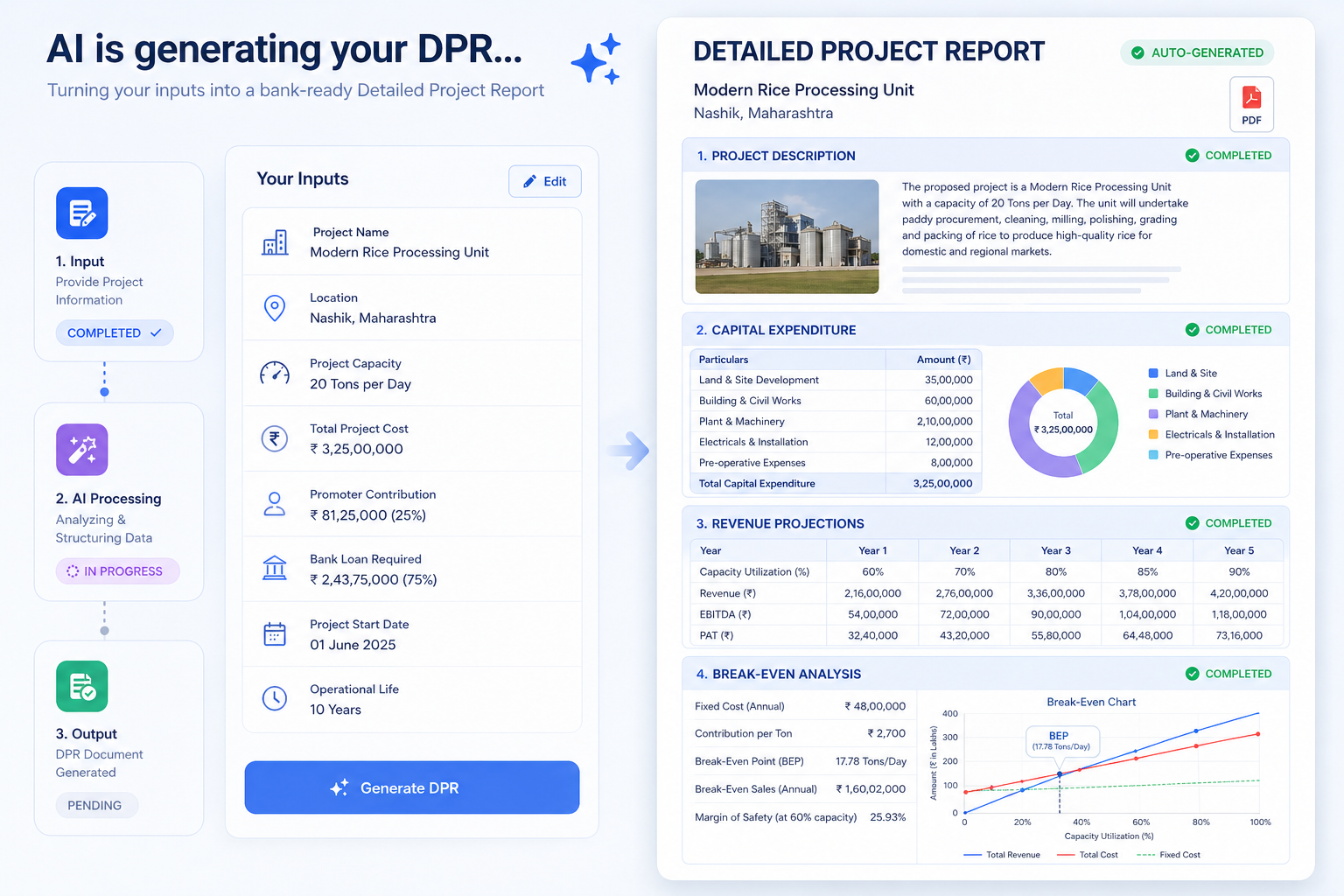
If you have ever walked into a bank branch to apply for a business loan and been told “submit a DPR”, you are not alone in wondering what exactly they want. A Detailed Project Report is the single most important document in an MSME term loan application and the one most small business owners are least prepared to produce.
This article explains what a DPR is, what it must contain, why it matters for loan approval, and the options for getting one prepared from doing it yourself to using a chartered accountant to using automated tools.
The one-line explanation
A DPR is a structured business plan that tells the banker: here is what I want to do, here is what it will cost, here is how I will repay, and here is what happens if things do not go exactly as planned.
What a DPR Contains- Section by Section
- Promoter Profile- Background, experience, qualifications, existing business history. The bank wants to know who is behind the project.
- Project Description- What the business will do, where it will operate, the product or service, the target market. Clear, specific, and concise.
- Capital Expenditure (Capex)- Itemised list of machinery, equipment, furniture, civil works, vehicles, and other fixed assets. Supported by quotations from suppliers.
- Working Capital Requirement- Raw material, inventory holding, operational expenses for the first 3-6 months until cash flow stabilises.
- Means of Finance- How the total project cost will be funded promoter contribution (equity), bank loan (debt), subsidy (if applicable e.g., PMEGP / CLCSS / PMFME). The debt-equity ratio matters here.
- Revenue Projections- Monthly or quarterly revenue forecast for the first 3-5 years, based on realistic assumptions about pricing, capacity utilisation, and market size.
- Operating Expenses- Salary, rent, utilities, raw material, marketing, insurance, maintenance month by month for at least the first year, annually thereafter.
- Profitability Statement- Projected Profit & Loss for 3–5 years, showing the path from initial investment to operating profit and net profit.
- Cash Flow Statement- Month-by-month projected cash inflows and outflows, demonstrating that the business can service the loan EMI along side operational expenses.
- Break-Even Analysis- The point at which revenues equal total costs. Banks want to see a break-even within 18–36 months for most MSME projects.
- Repayment Schedule- Loan amount, interest rate (assumed), tenure, EMI, and projected debt service coverage ratio (DSCR). A DSCR above 1.5 is generally comfortable for banks.
- Risk Assessment- What could go wrong (demand shortfall, raw material price spike, regulatory change) and how the project mitigates each risk. This section is often skipped by applicants but valued highly by credit officers.
Why Banks Insist on a DPR
A bank’s credit officer must justify the loan recommendation to their sanctioning authority. The DPR is the evidence base for that justification. Without it, the officer is recommending a loan on the strength of conversation alone no credit committee approves that.
Specifically, the DPR answers the three questions every banker asks:
- Will this project generate enough cash to repay the loan? (Cash flow statement, DSCR).
- What happens if the project underperforms? (Break-even, risk assessment, promoter contribution as skin-in-the-game).
- Is the promoter serious and capable? (Promoter profile, equity contribution, project knowledge demonstrated in the DPR itself).
Common DPR Mistakes That Get Loans Rejected
- Unrealistic revenue projections- Projecting 100% capacity utilisation from month 1 is a red flag. Banks expect 30-40% in year 1, scaling to 70-80% by year 3.
- Missing working capital calculation- The project has 40 lakh in machinery but no provision for raw material, salary, or rent for the first 6 months. The bank knows the business will run out of cash.
- Zero promoter contribution- Banks want skin-in-the-game. The standard expectation is 20-35% of the project cost from the promoter. A DPR that shows 100% bank funding signals that the promoter has nothing to lose.
- No risk section- Every business has risks. A DPR that claims none is not honest; it is naive. A good DPR names the risks and shows how they are managed.
- Copy-pasted templates- Banks have seen every generic DPR template on the internet. A DPR that does not reflect the specific project, location, and market is immediately recognisable as cut-and-paste.
- Missing supplier quotations- Capital expenditure claims without supporting quotations are unverifiable. Banks will ask have them ready.
Three Routes to a DPR- Pick What Fits
There is no single right way to get a DPR prepared. Each route has its place:
| Route | Best For | Trade-Off |
|---|---|---|
| Self-prepared (using a structured template) | Promoters with strong business and financial fluency, small project sizes | Time-intensive; quality depends on the promoter’s modelling skill |
| Chartered Accountant/consultant | Complex projects, specialised sectors, applications where professional review materially adds value (PMFME, CLCSS, large-ticket loans) | Higher fees; turnaround typically 5-15 days |
| Automated DPR(Vittus Fintech) | Standard MSME term loans, PMEGP, Mudra Tarun, CGTMSE-backed loans |
Structured templates produce consistent output quickly; complex sector-specific judgement still benefits from a CA’s review |
For most standard MSME applications, automated tools and CA-led preparation are complements, not substitutes. Many of our customers use the Vittus Fintech-generated DPR as a strong first draft and then have their CA review the assumptions before submission.
Which Loans Require a DPR?
- MSME term loans- Almost always required for amounts above 5-10lakh.
- PMEGP applications- Mandatory the DPR is the core application document [1].
- Stand-Up India- Required for greenfield enterprise applications
- CGTMSE-backed loans- Often required, though some lenders waive for smaller amounts
- CLCSS/PMFME/state subsidies- Mandatory; each has scheme specific framing requirements
- Working capital loans- Typically not required for CC/OD facilities banks rely on CMA (Credit Monitoring Arrangement) data instead. See our CMA vs DPR guide.
- Personal loans- Not applicable-DPR is a business-specific document.
Frequently Asked Questions
Can I write my own DPR without a CA?
Yes – there is no regulatory requirement for a DPR to be prepared by a chartered accountant. Many successful DPRs are prepared by the promoter them selves, particularly for smaller projects. The key is that the financial projections must be internally consistent and realistic. For complex or specialised cases, a qualified CA’s review remains valuable.
How long should a DPR be?
For most MSME projects, 15–25 pages is appropriate. Larger projects (1 crore+) may justify 30–50 pages. Quality and clarity matter more than length a concise, well-structured 20-page DPR is better than a 60-page document padded with generic industry data.
Will the bank modify my DPR after I submit it?
The bank’s credit officer may adjust your projections based on their own assessment typically making them more conservative. This is normal. A well prepared DPR gives the officer less reason to cut your numbers aggressively.
Is a DPR the same as a business plan?
Broadly yes, but a DPR is structured specifically for the lending context it emphasises financial feasibility, repayment capacity, and project cost breakdown. A business plan for investors or internal strategy may cover market positioning, team, and growth vision more extensively.
Do I need both a DPR and a CMA?
For a term loan, a DPR is the primary document. For a working capital limit, CMA is the primary document. Many growing businesses end up needing both a DPR for the new project + an updated CMA for the enhanced working capital. See our CMA vs DPR guide for the full comparison.
How does Vittus Fintech help with DPR preparation?
Vittus Fintech (loanvittus.com) auto-generates DPRs from structured inputs you answer questions about your business, project cost, and revenue expectations; the platform produces a bank-format DPR with financial projections, break-even analysis, DSCR calculation, and repayment schedule. The output is
formatted to what banks actually expect and serves as a strong starting point for highly complex or specialised projects, a qualified Chartered Accountant’s review adds value on top.
Related Reading from Vittus Fintech → MSME Loan in India:
Complete Guide for Small Business Owners–
loanvittus.com/blog/msme-loan-india-complete-guide → CMA vs DPR- When You Need Which Document-loanvittus.com/blog/cma-vs-dpr-difference-when-needed → CDSCR Explained: How Banks Decide If You Can Repay- loanvittus.com/blog/dscr-debt-service-coverage-ratio-msme
Sources & References
[1] KVIC / PMEGP Guidelines on DPR requirements- kviconline.gov.in
[2] SIDBI- Project Finance Guidelines- sidbi.in
[3] DIC (District Industries Centre)- DPR format guidelines
[4] IBA Standard DPR format reference- iba.org.in
Need a Loan? Check Your Eligibility in 2 Minutes
- Personal Loans
- MSME Loans
- Loans Against Mutual Funds Apply now at loanvittus.com/apply
About Vittus Fintech
Vittus Fintech Private Limited (loanvittus.com) is a technology-driven loan facilitation platform operating as a Lending Service Provider (LSP) under RBI’s Digital Lending Guidelines that connects borrowers with the right lending partners (RBI-regulated banks and NBFCs) for personal loans, MSME business loans, and loans against mutual funds. Our platform features automated DPR (Detailed Project Report) and CMA (Credit Monitoring Arrangement) generation for MSME borrowers and government subsidy eligibility checks. We do not lend directly; we simplify the borrowing process through technology, transparency, and unbiased comparison.
Disclaimer
This article is for educational and informational purposes only and does not constitute financial, legal, tax, or investment advice. Vittus Fintech Private Limited operates as a Lending Service Provider (LSP) under RBI’s Digital Lending Guidelines and does not lend directly all loans are disbursed by RBI-regulated partner banks and NBFCs whose policies, interest rates, processing fees, and eligibility criteria apply. DPR formats, scheme requirements, and bank acceptance norms are believed accurate as of the date of publication but are subject to change. For complex, specialised, or high-value projects, professional review by a qualified Chartered Accountant is recommended in addition to any automated tool.
