


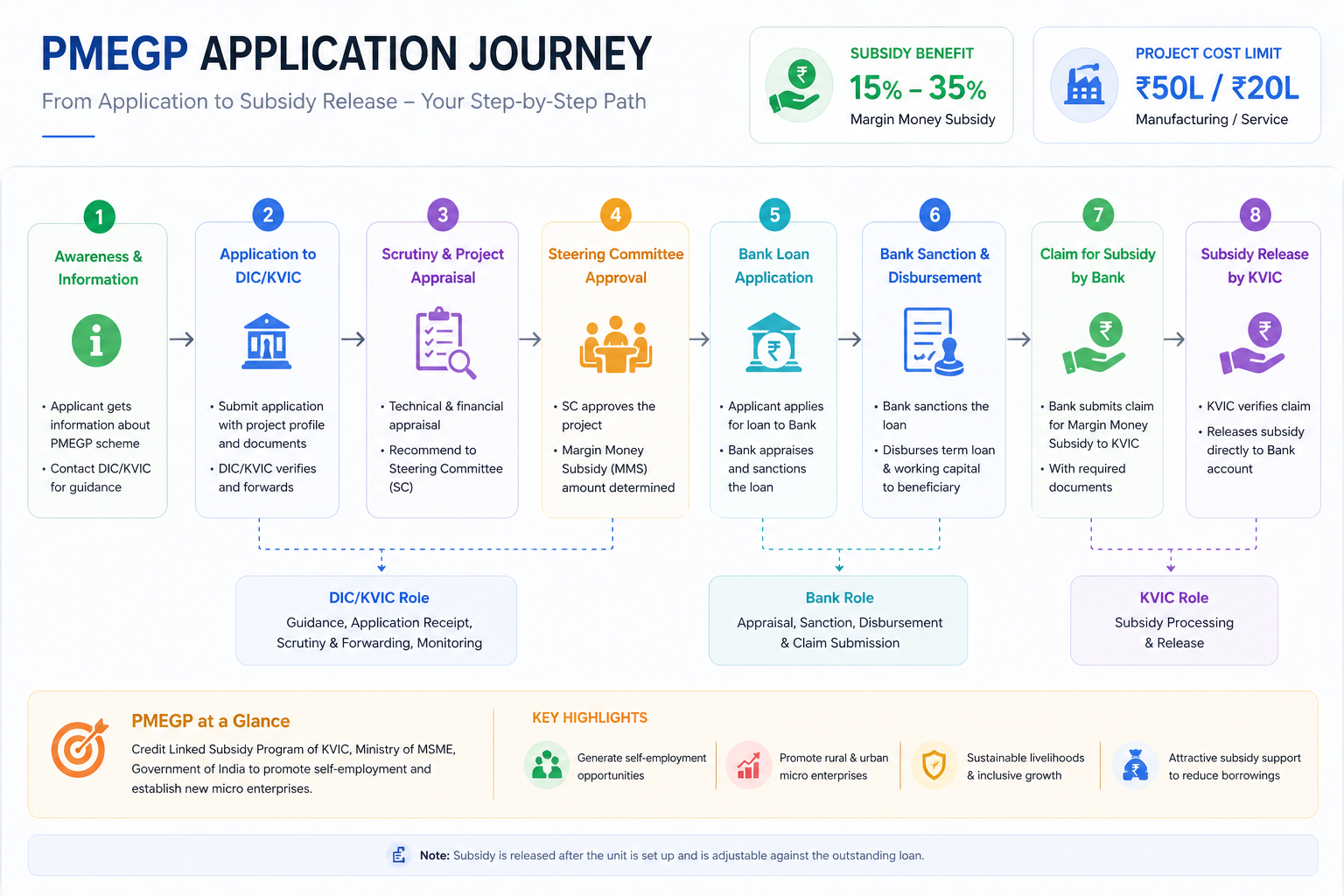
The Prime Minister’s Employment Generation Programme (PMEGP) is one of India’s most generous subsidy schemes for new micro-enterprises offering 15-35% of the project cost as a government subsidy that never needs to be repaid. Despite this, most eligible entrepreneurs either do not know the scheme exists or abandon the application halfway through because the process feels opaque.
This guide walks through PMEGP end-to-end: who qualifies, how much you get, what documentation you need, and the common pitfalls that cause applications to fail.
The headline number
For a new manufacturing unit with a 50 lakh project cost, a general category applicant in a rural area receives a 12.5 lakh subsidy (25%). An SC / ST / woman / PwD / Ex-servicemen applicant in a rural area receives 17.5 lakh (35%). This is a grant not a loan. It directly reduces the amount you need to borrow and repay [1].
What Is PMEGP?
PMEGP is a centrally sponsored scheme administered by the Khadi and Village Industries Commission (KVIC), state KVI Boards, and District Industries Centres (DICs). It provides a margin money (capital) subsidy for setting up new micro-enterprises in manufacturing and service sectors. The scheme has been continued through subsequent Union Budgets and remains active.
The scheme covers both manufacturing enterprises (project cost up to 50 lakh) and service enterprises (project cost up to 20 lakh). The subsidy is calculated on the eligible project cost and routed via the bank that sanctions the loan.
Subsidy Rates
| Applicant Category | Urban Area Subsidy | Rural Area Subsidy |
|---|---|---|
| General Category | 15% of project cost | 25% of project cost |
| SC / ST / OBC / Women / PwD / Ex-Servicemen / NER / Hill & Border Areas / Aspirational Districts / Transgender | 25% of project cost | 35% of project cost |
Promoter’s contribution requirement:
- General category- 10% of the project cost.
- Special category (SC / ST / OBC / Women / PwD / Ex Servicemen / NER / Aspirational Districts)-
5% of the project cost.
The remaining amount (project cost-subsidy-promoter contribution) is the bank loan.
Eligibility Criteria
- Age- 18years and above.
- Education- Minimum 8th pass for projects above 10 lakh in manufacturing and 5 lakh in service sector.
- New enterprises only- PMEGP is for new units, not for upgrading or expanding existing businesses.
- No previous government subsidy- Applicants who have already availed any other government subsidy on the same project (PMRY, REGP, or any state scheme of similar nature) are not eligible.
- Self-help groups- SHGs that have not availed benefits under any other scheme are eligible.
- Institutions registered under the Societies Registration Act- Cooperative societies and charitable trusts are eligible.
- Not eligible- Existing units, units already availing similar government subsidy, and industry types on the negative list (beedi, tobacco / khaini / cigar / cigarette / pan-masala, intoxicants, polythene carry bags below specified microns, etc. refer to the latest negative list on the PMEGP portal).
The Application Process- Step by Step
- Register on the PMEGP e-portal (kviconline.gov.in/pmegpeportl). Fill the online application form with personal details, project description, and cost estimates.
- Submit the application to the nearest KVIC / KVIB / DIC office, along with required documents.
- The application is screened at the district level by a District Level Task Force Committee (DLTFC) or State Level Task Force Committee (SLTFC).
- If shortlisted, the applicant undergoes EDP (Entrepreneurship Development Programme) training typically of the prescribed duration, facilitated by KVIC or authorised training centres.
- After EDP, the application and DPR are forwarded to a bank branch for loan sanction [1].
- The bank evaluates the DPR independently and sanctions the loan. The bank applies to KVIC for release of the margin money subsidy.
- KVIC releases the subsidy amount to the bank. The subsidy is kept in a Term Deposit (TDR) in the borrower’s name for the lock-in period prescribed by the scheme. After successful completion of the lock-in and satisfactory loan repayment, the TDR is adjusted against the outstanding loan.
DPR Requirements for PMEGP
A DPR is mandatory for every PMEGP application. The DPR must include: project description, capital expenditure itemisation, working capital estimate, means of finance (showing subsidy + loan + promoter contribution), revenue and expense projections, break-even analysis, and employment generation estimate. The employment generation figure is particularly important. PMEGP is fundamentally an employment-generation scheme, and the DPR is evaluated partly on the jobs the project will create.
Common Mistakes That Cause PMEGP Applications to Fail
- Applying for an existing business- PMEGP is strictly for new enterprises. If the business already exists, the application is rejected.
- Inflated project cost- Applicants sometimes inflate the project cost to maximise the subsidy amount. Banks verify quotations independently inflated costs lead to rejection or downward revision.
- Weak DPR- A generic or copy-pasted DPR is the fastest way to get rejected at the bank stage. The DPR must reflect the specific project with realistic financial projections.
- Not completing EDP training- EDP is mandatory. Applicants who skip or fail to complete the training are not forwarded to the bank.
- Choosing a non-viable project- The bank will reject a project that does not demonstrate repayment capacity. Choose a project with proven demand and achievable break-even within 2-3 years.
- Applying to the wrong implementing agency- KVIC, KVIB, and DIC each have jurisdiction over certain project types and locations. Applying to the wrong agency delays or kills the application.
Frequently Asked Questions
Is the PMEGP subsidy a loan or a grant?
It is a grant – you never repay the subsidy portion. The subsidy is released by KVIC to the bank and held as a Term Deposit for the lock-in period. After successful completion of the lock-in and satisfactory loan repayment, it is adjusted against your outstanding loan balance, effectively reducing your total borrowing.
Can I apply for PMEGP online?
Yes – the entire initial application is submitted through the PMEGP e-portal at kviconline.gov.in/pmegpeportal. Physical documents are submitted to the local KVIC / KVIB / DIC office for verification.
How long does the PMEGP process take?
From application to loan disbursement: typically 3-6 months, depending on the speed of DLTFC screening, EDP training scheduling, and bank processing. Delays are common factor this into your project timeline.
Can I get PMEGP for a service business?
Yes – PMEGP covers both manufacturing (up to 50 lakh project cost) and service enterprises (up to 20 lakh). Service businesses include salons, repair shops, diagnostic labs, coaching centres, logistics services, and many others subject to the negative list.
How is PMEGP different from CLCSS, PMFME, and Stand-Up India?
PMEGP is for new micro-enterprises across manufacturing and services with margin money subsidy. CLCSS is for technology upgradation in existing MSMEs (51 sub-sectors, 15% capital subsidy). PMFME is specifically for food processing (35% subsidy). Stand-Up India is for SC/ST/women entrepreneurs starting greenfield enterprises (composite 10L-1Cr loan). Each scheme has a distinct purpose; in many cases an entrepreneur is eligible for more than one and should choose carefully.
How does Vittus Fintech help with PMEGP?
Vittus Fintech (loanvittus.com) checks your PMEGP eligibility based on your profile, generates a PMEGP-format DPR automatically, and connects you with banks experienced in processing PMEGP applications. We guide you through the application process step by step from e-portal registration to bank sanction. For complex projects, professional review by a qualified Chartered Accountant in addition to the automated tool is recommended.
Related Reading from Vittus Fintech → What Is a DPR and Why Every MSME Loan Needs One– loanvittus.com/blog/what-is-dpr-detailed-report-msme-loan → Mudra Loan: Shishu, Kishore, Tarun– Which One Fits Your Business– loanvittus.com/blog/mudra-loan-shishu-kishore-tarun-guide → Stand-up India Scheme- Loans for SC/ST and Women Entrepreneurs-loanvittus.com/blog/stand-up-india-scheme-sc-st-women-entrepreneurs→ WCLCSS- 15% Capital Subsidy for MSME Technology Upgradation-loanvittus.com/blog/clcss-credit-linked-capital-subsidy-scheme
Sources & References
[1] PMEGP Scheme Guidelines (Ministry of MSME)- kviconline.gov.in
[2] KVIC- PMEGP Portal-kviconline.gov.in/pmegpeportal
[3] Ministry of MSME Annual Report- msme.gov.in
[4] Negative List of PMEGP Activities- kviconline.gov.in
Need a Loan? Check Your Eligibility in 2 Minutes
- Personal Loans
- MSME Loans
- Loans Against Mutual Funds Apply now at loanvittus.com/apply
About Vittus Fintech
Vittus Fintech Private Limited (loanvittus.com) is a technology-driven loan facilitation platform operating as a Lending Service Provider (LSP) under RBI’s Digital Lending Guidelines that connects borrowers with the right lending partners (RBI-regulated banks and NBFCs) for personal loans, MSME business loans, and loans against mutual funds. Our platform features automated DPR (Detailed Project Report) and CMA (Credit Monitoring Arrangement) generation for MSME borrowers and government subsidy eligibility checks. We do not lend directly; we simplify the borrowing process through technology, transparency, and unbiased comparison.
Disclaimer
This article is for educational and informational purposes only and does not constitute financial, legal, tax, or investment advice. Vittus Fintech Private Limited operates as a Lending Service Provider (LSP) under RBI’s Digital Lending Guidelines and does not lend directly all loans are disbursed by RBI-regulated partner banks and NBFCs whose policies, interest rates, processing fees, and eligibility criteria apply. PMEGP scheme parameters, subsidy quanta, eligibility, and the negative list are believed accurate as of the date of publication but are subject to change by KVIC / Ministry of MSME; readers must verify the latest scheme guidelines on the official PMEGP portal before taking financial decisions. For complex applications, professional review by a qualified Chartered Accountant is recommended.
