


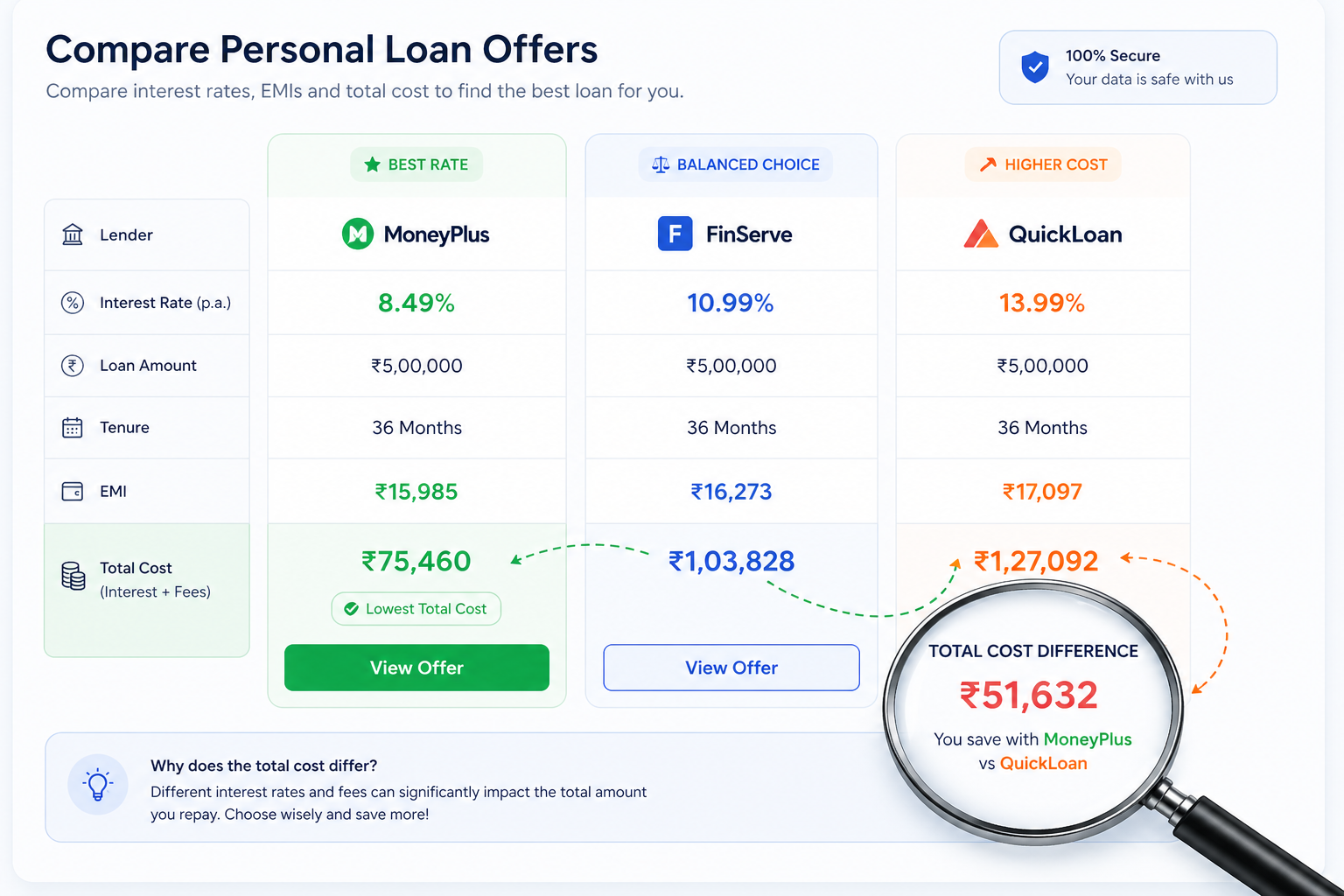
A personal loan is the most flexible form of unsecured credit available to salaried and self-employed individuals in India. No collateral, no end-use restriction, funds in your account within hours to days. The flexibility is also the risk personal loans carry higher interest rates than secured borrowing, and the ease of access makes it dangerously easy to borrow more than you should.
This guide covers what personal loans actually cost, who qualifies, how to compare offers honestly, and when a personal loan is the right (and wrong) choice.
The honest framing
A personal loan is a tool, not a solution. Used well (debt consolidation at a lower rate, a genuine emergency, a planned large expense), it is efficient. Used poorly (lifestyle spending, speculative investment, covering a cash flow problem that recurs monthly), it accelerates a financial problem rather than solving it.
Current Personal Loan Interest Rates in India (2026)
Interest rates vary significantly based on the lender, your credit profile, income level, and employer category. Indicative ranges as of date of publication; subject to lender repricing:
| Lender Type | Rate Range (p. a.) | Best For |
|---|---|---|
| Public Sector Banks (SBI, BOB, PNB) | 10.5-14% | Government / PSU employees, larger amounts |
| Private Banks (HDFC, ICICI, Kotak) | 10.5-18% | Salaried in top corporates, quick disbursal |
| NBFCs (Bajaj, Tata, Fullerton) | 12-26% | Winder eligibility, flexible tenure |
| Fintech / digital lenders (RBI-regulated NBFC partners only) | 14-36% | Small amounts, instant approval, thin-file borrowers |
The advertised “starting from” rate is almost always the rate for the best profile (high income, 800+CIBIL, top employer). Most borrowers pay 2-6% above the advertised minimum. Always ask for the specific rate applicable to your profile before accepting and verify that it appears in the lender’s Key Fact Statement
(KFS) before disbursement.
Eligibility Criteria- What Lenders Check
- Age- 21-60 for salaried; 25-65 for self-employed (varies by lender).
- Minimum income- 15,000-25,000/month net for salaried (varies); higher thresholds for self-employed.
- Employment stability- Salaried: minimum 1-2 years total experience, 6 months in current job. Self-employed: 2-3 years ITR history.
- CIBIL score- 700+ for most mainstream lenders; 750+ for the best rates. Below 650 limits you to NBFCs and fintech’s at materially higher rates.
- FOIR (Fixed Obligation to Income Ratio)- Banks typically cap total EMIs (existing + proposed) at 40-55% of net monthly income. If your existing EMIs already consume 50%, a new personal loan is unlikely to be approved at a reasonable amount.
- Employer category- Banks maintain internal lists of “approved” employers. Employees of listed companies, MNCs, and government bodies get preferential rates and higher limits.
How to Compare Personal Loan Offers- The Right Way
Most borrowers compare the interest rate and stop there. The actual cost of a personal loan includes several components:
- Interest rate (the headline number)- The annualised rate. Always confirm whether it is a flat rate or a reducing-balance rate flat rates look lower but cost more in real terms.
- Processing fee- 0.5-3% of the loan amount, deducted upfront. On a 10 lakh loan, a 2% processing fee means you receive 9.8 lakh but repay EMIs on 10 lakh.
- Prepayment / foreclosure charges- 2-5% of the outstanding principal if you close the loan early. For floating-rate personal loans extended to individual borrowers for non-business purposes, RBI has prohibited prepayment / foreclosure charges. For fixed-rate loans, charges typically apply. If there is any chance you will prepay, this matters significantly.
- Total cost of borrowing- The sum of all interest paid + processing fee + any other charges over the full tenure. Under RBI’s Digital Lending Guidelines, every digital lender is required to disclose the Annual Percent age Rate (APR) the all-in cost of borrowing, including fees in the Key Fact Statement (KFS) provided before sanction.
- Insurance bundled into the loan- Some lenders bundle loan protection insurance into the EMI. This is optional; you can decline it. The insurance premium adds to the effective cost.
The comparison that matters
Compare the total cost of borrowing (the APR in the KFS), not the headline interest rate. A 12% loan with 2% processing fee and 4% foreclosure charge can be more expensive than a 13% loan with zero processing fee and zero foreclosure charge especially if you plan to prepay early.
When a Personal Loan Is the Right Choice
- Debt consolidation- If you have multiple high-interest debts (credit cards at 36-42% APR, BNPL at 18-24%) consolidating them into a single personal loan at 12–14% reduces total interest and simplifies cash flow.
- Genuine emergency- Medical bills, urgent home repairs, family obligations when the alternative is a credit card cash advance at 42% or a personal loan at 13%, the personal loan wins.
- Planned large expense with clear repayment path- A wedding, a professional certification course, a non-speculative investment with clear payback when the expense is non-recurring and the repayment source is identified.
When a Personal Loan Is the Wrong Choice
- Lifestyle spending- A vacation, gadgets, or a car upgrade funded by a personal loan is spending tomorrow’s income today. The interest cost compounds the damage.
- Investing in stocks or crypto- Borrowing at 14% to invest in assets that may or may not return 14% is speculation, not investing.
- Covering a recurring cash flow gap- If you need a personal loan every year to cover December expenses, the problem is the budget, not the loan.
- When a secured loan is available at lower cost- Loan against mutual funds (8-10.5%), loan against property (8.5-12%), gold loan (7-12%) all carry meaningfully lower rates than an unsecured personal loan. If you have assets to pledge, explore secured options first.
Common Mistakes Borrowers Make
- Not checking CIBIL before applying- A rejected application itself hurts your score. Check your score first (free on CIBIL, Experian, CRIF). If it is below 700, fix it before applying.
- Accepting the first offer- Interest rates for the same borrower profile can vary by 3-8% across lenders. Comparing 3-5 offers takes 30 minutes and can save lakhs over the tenure.
- Choosing the longest tenure for lowest EMI- A 5 lakh loan at 14% for 5 years costs 2.05 lakh in interest. The same loan for 3 years costs 1.16 lakh in interest nearly 90,000 less. Choose the shortest tenure you can comfortably afford.
- Ignoring the loan agreement fine print- Foreclosure charges, late payment penalties, interest rate reset clauses (for floating-rate products) all buried in the agreement. Read the KFS and the loan agreement before signing.
- Borrowing more than needed- Banks will sanction the maximum they can lend. That does not mean you should take the maximum. Borrow only what the specific need requires.
- Borrowing from unregulated digital apps- Many “instant loan” apps operate outside the RBI regulatory perimeter. Always verify that the actual lender (the entity sanctioning the loan) is an RBI-regulated bank or NBFC, listed on the RBI website. Vittus Fintech only routes applications to RBI-regulated lenders.
Frequently Asked Questions
What CIBIL score do I need for a personal loan?
700+ gets you access to most mainstream lenders at competitive rates. 750+ unlocks the best rates and highest limits. Between 650–700, options narrow to select NBFCs at higher rates. Below 650, only fintech lenders and secured alternatives are realistic.
Can I get a personal loan if I am self-employed?
Yes, but the documentation bar is higher 2-3 years ITR, audited financials, bank statements, GST returns. Self-employed borrowers typically pay 1-3% higher rates than salaried borrowers with the same credit profile.
Is it better to take a personal loan or use a credit card for a large expense?
Almost always a personal loan. Credit card revolving interest is 36-42% APR (3-3.5% per month). A personal loan at 12–16% is less than half the cost. The only exception: if you can pay the credit card bill in full within the interest-free period.
Can I prepay a personal loan early?
For floating-rate personal loans extended to individual borrowers for non business purposes, RBI prohibits prepayment penalties. For fixed-rate loans, most lenders allow prepayment after a minimum lock-in (typically 6-12 months) with charges between 0% and 5% of outstanding principal. Always verify the specific terms in your loan agreement before signing.
How do I know whether a digital lender is RBI-regulated?
Every legitimate digital loan in India is sanctioned by an RBI-regulated bank or NBFC, even if the customer-facing app is operated by a fintech. The Key Fact Statement (KFS) issued at sanction must name the actual lender, which can be cross-checked against the RBI website (rbi.org.in → “Banks/NBFCs in India”). If the app refuses to disclose the regulated lender’s name, do not borrow.
How does Vittus Fintech help with personal loans?
Vittus Fintech (loanvittus.com) compares personal loan offers across RBI regulated banks and NBFCs for your specific profile income, CIBIL score, employer category and shows you the total cost of borrowing (not just the headline rate). We also flag when a loan against mutual funds or other secured option would be cheaper. We operate as a Lending Service Provider (LSP) under RBI’s Digital Lending Guidelines and do not lend directly.
Related Reading from Vittus Fintech → CIBIL Score for Business Loans: What Banks Actually Check–
loanvittus.com/blog/cibil-score-business-loan-india → Loan Against Mutual Funds: The Smarter Way to Borrow– loanvittus.com/blog/cibil-score-business-loan-india → How Loan Aggregator Platforms Work and Why They Save You Money– loanvittus.com/blog/loan-aggregator-platform-india-how-it-works
Sources & References
[1] RBI- Master Direction on Interest Rate on Advances- rbi.org.in
[2] RBI Guidelines on Digital Lending, September 2022-rbi.org.in
[3] RBI- Foreclosure Charges / Pre-payment Penalty on Floating Rate Term Loans- rbi.org.in
[4] CIBIL- TransUnion credit score methodology- cibil.com
Need a Loan? Check Your Eligibility in 2 Minutes
- Personal Loans
- MSME Loans
- Loans Against Mutual Funds Apply now at loanvittus.com/apply
About Vittus Fintech
Vittus Fintech Private Limited (loanvittus.com) is a technology-driven loan facilitation platform operating as a Lending Service Provider (LSP) under RBI’s Digital Lending Guidelines that connects borrowers with the right lending partners (RBI-regulated banks and NBFCs) for personal loans, MSME business loans, and loans against mutual funds. Our platform features automated DPR (Detailed Project Report) and CMA (Credit Monitoring Arrangement) generation for MSME borrowers and government subsidy eligibility checks. We do not lend directly; we simplify the borrowing process through technology, transparency, and unbiased comparison.
Disclaimer
This article is for educational and informational purposes only and does not constitute financial, legal, tax, or investment advice. Vittus Fintech Private Limited operates as a Lending Service Provider (LSP) under RBI’s Digital Lending Guidelines and does not lend directly all loans are disbursed by RBI-regulated partner banks and NBFCs whose policies, interest rates, processing fees, and eligibility criteria apply. Indicative rates and ranges referenced in this article are believed accurate as of the date of publication but are subject to change by lenders without notice; readers must verify the latest provisions and applicable Key Fact Statement before taking financial decisions. Past performance, indicative numbers, or illustrative calculations are not guarantees of future outcomes. For case-specific advice, consult a qualified Chartered Accountant, advocate, or registered investment adviser.
