

Find out how much you can borrow in just a few clicks. No paperwork, no hidden steps just quick and clear results.

Choose the right financing option for your business requirements
Upgrade or purchase new machinery and equipment to boost your production capacity and efficiency.



Our streamlined process ensures quick access to business funding







Find answers to commonly asked questions about our MSME loan offerings
We support: (a) MSME Term Loans (for equipment, machinery, infrastructure), (b) Working Capital Loans (Cash Credit/Overdraft), (c) Project Loans (for new ventures with DPR), (d) CGTMSE-backed collateral-free loans up to ₹2 Crore, (e) MUDRA Loans (Shishu up to ₹50,000, Kishore up to ₹5 Lakh, Tarun up to ₹10 Lakh), and (f) Subsidy-linked project loans under PMEGP and state schemes.
Generally yes, if your business is classified as Micro, Small, or Medium Enterprise under the MSMED Act (Udyam registered or eligible), you have valid business registration, a viable plan, and satisfactory credit history. Specific criteria vary by lender and product. LoanVittus assesses your eligibility and helps explore the best-fit loan product.
Depends on your business turnover, project cost, existing liabilities, credit score, and DPR/CMA strength. There is no universal fixed limit. Under CGTMSE, collateral-free loans up to ₹2 Crore may be available. Under MUDRA, maximum is ₹10 Lakh. LoanVittus analyses your profile and provides an estimated eligibility range.
Not always. CGTMSE-backed loans (up to ₹2 Crore, subject to eligibility and lender discretion), MUDRA loans (collateral-free by design), and some NBFC products may not require collateral. Larger amounts or certain bank products may need property or guarantee. LoanVittus helps explore collateral-free options for your profile.
A Detailed Project Report (DPR) is a comprehensive document covering your project cost, means of finance, revenue projections, profitability, and loan repayment capacity. Banks use it to evaluate whether your project is viable and whether you can repay the loan. For term loans and project loans, most banks will not process your application without a properly prepared DPR. LoanVittus generates bank-ready DPRs automatically based on your inputs.
CMA (Credit Monitoring Arrangement) is a financial data format banks use to assess working capital needs. It includes your current and projected Balance Sheet, P&L, Fund Flow, and working capital assessment. Required for Cash Credit, Overdraft, and working capital proposals. LoanVittus generates CMA in standard banking format.
PAN, Aadhaar, Udyam Registration, business registration (GST certificate, partnership deed, MOA/AOA as applicable), last 2-3 years ITR, audited financials, 12 months bank statements, project quotations (for new projects), and DPR/CMA (which LoanVittus generates). Specific banks may request additional documents during appraisal.
MUDRA loans: 7-15 working days. MSME term loans (up to ₹50 Lakh): 10-25 days. Project loans with DPR: 15-45 days. Working capital (CC/OD): 15-30 days. Timelines depend on bank appraisal, documentation completeness, and loan amount. A complete application from day one reduces delays significantly.
Common reasons: incomplete or inconsistent financials (ITR/bank statement/GST mismatch), weak or missing DPR/CMA, low credit score, high existing debt, working capital gap not properly justified, wrong loan product or amount, or insufficient promoter contribution. LoanVittus helps identify and address each of these before you apply.
Getting rejected doesn’t mean your business is weak often the application was poorly structured. We analyse likely reasons, help reorganise your financials, prepare a fresh DPR/CMA addressing gaps, and assist in reapplying to the same or a more suitable lender.
Indicative ranges: MUDRA- 8-12% p.a.; MSME term loans- 9-16% p.a.; Working capital (CC/OD)- 9-15% p.a. Rates may vary based on borrower profile, lender policy, and economic conditions. LoanVittus does not set rates these are determined by the lending institution.
Step 1: Sign up and enter your details. Step 2: System analyses your profile and project viability. Step 3: DPR/CMA generated in bank-ready format. Step 4: Suitable loan products and lenders explored. Step 5: Application prepared with complete documentation. Step 6: Submission support and follow-up with the bank.
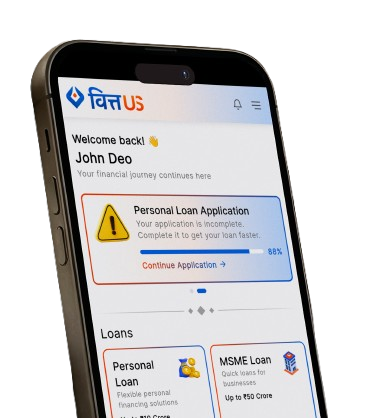
Take the first step towards your business goals. Apply for a loan today and experience the VITTUS difference.